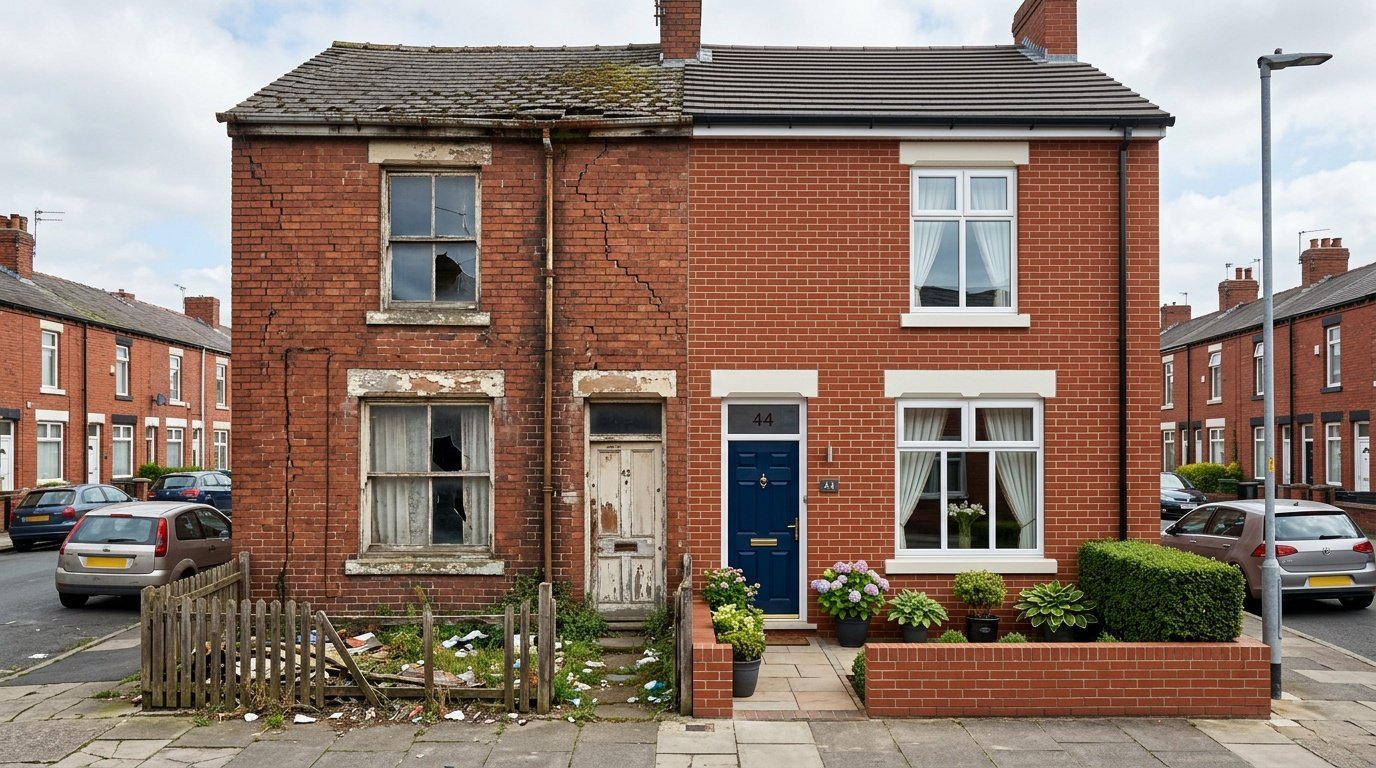
One of the questions we get asked most often at Bolton Surveyor is this: "Which survey do I actually need?" It's a fair question. With three RICS home survey levels now available — and a bewildering amount of conflicting advice online — it's easy to feel overwhelmed.
In this guide, I'll walk you through the key differences between a Level 2 Home Survey (the Homebuyer Report) and a Level 3 Building Survey (the full structural survey), and help you decide which is right for your property purchase in Bolton and the wider North West.
Quick answer: For most standard modern homes in Bolton, a Level 2 survey is sufficient. For older, larger, or more complex properties — particularly anything pre-1930 or showing visible signs of defects — a Level 3 survey is strongly recommended.
What Are the Three RICS Survey Levels?
Since 2021, the RICS has standardised residential surveys into three tiers:
- Level 1 – Condition Report: A basic visual inspection with traffic-light condition ratings. No valuation. Best for new-build or very modern properties.
- Level 2 – Home Survey (Homebuyer Report): The most popular survey. A visual inspection with condition ratings, advice on defects and legal matters, and an optional valuation.
- Level 3 – Building Survey (Full Structural Survey): The most comprehensive option. A detailed analysis of all accessible elements, repair cost guidance, and in-depth structural commentary.
The Level 2 Homebuyer Report: What Is It?
The Level 2 Homebuyer Report is by far the most commonly commissioned survey in the UK. According to RICS data, it accounts for around 38% of all surveys carried out annually. It's designed for relatively modern properties in reasonable condition, and it gives buyers a solid, colour-coded assessment of the property's main elements.
The report uses a traffic-light system:
- Condition Rating 1 (Green): No repairs needed — just routine maintenance.
- Condition Rating 2 (Amber): Defects needing repair, but not urgent or serious.
- Condition Rating 3 (Red): Serious defects requiring immediate action or further investigation.
When I carry out a Level 2 survey in Bolton, I'm inspecting all the main visible elements: roof coverings, chimneys, external walls, windows and doors, gutters and downpipes, internal walls and ceilings, floors, kitchens, bathrooms, and electrics. I'll also test the walls for damp using a moisture meter.
The key word is visible. A Level 2 survey is a non-invasive inspection. I won't lift floorboards, move furniture, or break into sealed areas. If something is concealed, I'll flag it as "not inspected" and may recommend further investigation.
"I recently did a Level 2 survey on a 1960s semi in Westhoughton. The report flagged a Condition 3 issue with the flat roof on the rear extension — which the buyer was able to use to negotiate a £3,500 reduction in price. That's the Level 2 survey doing exactly what it's designed to do."
— James Whitfield, Lead Surveyor
The Level 3 Building Survey: What Is It?
The Level 3 Building Survey is the gold standard of residential property surveys. It's more thorough, takes longer, and costs more — but for the right property, it's absolutely worth the additional investment.
Unlike the Level 2, a Level 3 survey involves a much deeper investigation of the property's structure, fabric, and condition. I'll inspect the loft, check beneath floor coverings where I'm able to, examine the roof void, and carry out a much more detailed analysis of any defects I find. Where a Level 2 report flags a crack as "Condition Rating 2 — monitor and repair," a Level 3 report will attempt to explain why the crack is there, how serious it is, and what remedial action is needed.
Crucially, a Level 3 survey also includes estimated repair costs for significant defects. This is enormously valuable when you're negotiating a purchase price or planning a renovation budget.
Which Survey Do You Need? — A Simple Decision Guide
| Property Type | Recommended Survey | Reason |
|---|---|---|
| New build or modern home (post-2000) | Level 1 or Level 2 | Unlikely to have significant defects |
| Standard semi/terrace (1930–2000) | Level 2 | Adequate for most standard properties |
| Victorian or Edwardian terrace (pre-1920) | Level 3 | Older stock with higher risk of hidden defects |
| Property showing visible defects | Level 3 | Need detailed analysis and repair cost estimates |
| Older stone cottage or unusual construction | Level 3 | Non-standard materials need specialist assessment |
| Large detached or period property | Level 3 | Complexity warrants full structural survey |
| Flat in older conversion | Level 2 or Level 3 | Depends on age and condition — ask your surveyor |
What About the Cost Difference?
The cost of a survey depends on the property's location, size and value. Generally, a Level 2 Homebuyer Report in Bolton will cost less than a Level 3 survey — often considerably so. However, when you consider the potential cost of missing a serious structural issue, the extra cost of a Level 3 survey on an older property is almost always worthwhile.
To put it bluntly: I've seen buyers save £20,000 or more because a Level 3 survey identified problems they didn't know existed. I've never heard of anyone wishing they'd saved money by doing a less thorough survey.
Our Advice for Bolton Buyers
Bolton has a lot of Victorian and Edwardian housing stock — particularly in areas like Tonge Moor, Halliwell, Astley Bridge and the older parts of Horwich and Farnworth. If you're buying in any of these areas, I would almost always recommend a Level 3 Building Survey.
For more modern properties — post-war semis in Westhoughton, newer builds in Lostock or Harwood — a Level 2 Homebuyer Report is usually sufficient. If you're buying a flat, the age of the building and the leasehold structure are both important factors. Contact us and we'll give you honest, free advice about which survey is right for your specific property.
Frequently Asked Questions
Yes — provided the inspection hasn't been carried out yet. If you've already instructed us for a Level 2 and the property gives you cause for concern, speak to us before the inspection day and we can often upgrade. After the inspection has been done, a separate Level 3 visit would be needed.
No. A Level 3 Building Survey covers the entire property — its condition, fabric, drainage, and structural elements. A structural engineer's report focuses on a specific structural issue (a crack, a beam, a wall). For most buyers, a Level 3 survey is more appropriate; a structural engineer is called in when a specific structural concern has already been identified.
An RICS market valuation can be added as an optional extra to both Level 2 and Level 3 surveys. If you need a formal valuation (e.g. for mortgage purposes), note that most lenders require their own panel valuation anyway.