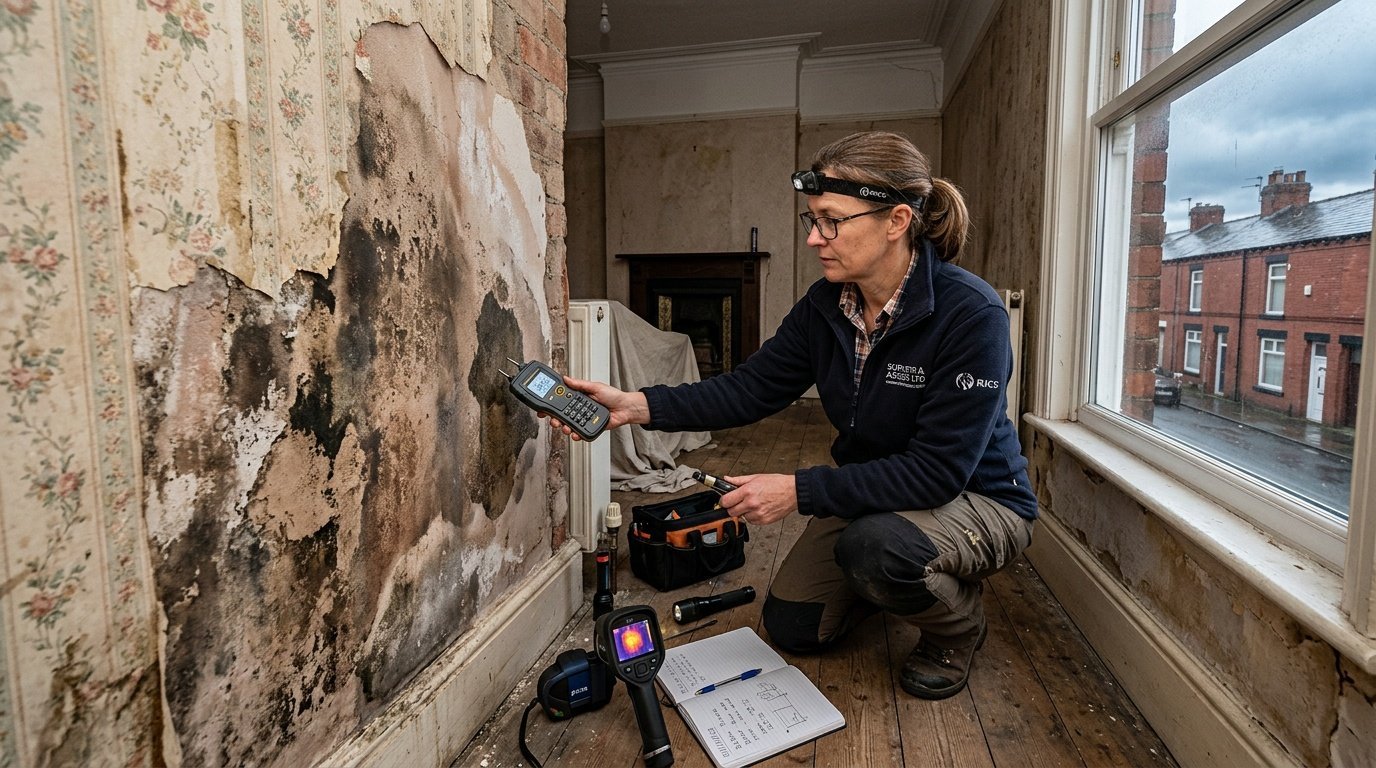
In over eight years of surveying properties across Bolton, I've lost count of how many times damp has been either misdiagnosed or misrepresented. It's one of the most common issues I find in Bolton's older housing stock — and also one of the most misunderstood. This guide is for anyone buying or owning a property in Bolton who wants to understand damp properly, without the sales pitch.
Why Is Damp So Common in Bolton?
Bolton has a lot of older housing. Victorian terraces, back-to-back properties and Edwardian semis make up a significant proportion of the town's residential property. These buildings were designed before modern materials and damp-proofing techniques were developed. Add the North West's relatively high rainfall to the mix, and damp becomes a fairly predictable challenge.
That said, damp isn't inevitable — and in many properties where it appears to be present, the actual cause is far simpler to fix than the expensive treatments often recommended by specialist damp companies. The key is understanding which type of damp you're dealing with.
The Three Main Types of Damp
1. Rising Damp
Rising damp is groundwater that travels upward through the wall structure via capillary action — essentially, the walls soak up moisture from the ground below. You'll typically see it as a tide mark on the lower section of walls, often with salt crystallisation and peeling plaster or paint.
True rising damp requires a failed or absent damp proof course (DPC) — the horizontal barrier built into walls to stop moisture rising. It's less common than many damp companies would have you believe, and it's often confused with condensation or other forms of moisture ingress.
— Helen Marsden, RICS Surveyor
2. Penetrating Damp
Penetrating damp enters the property from outside — through defective roof coverings, cracks in external walls, failed pointing, leaking gutters or downpipes, or defective window and door seals. Unlike rising damp, it can appear anywhere on a wall, not just near the bottom.
The fix for penetrating damp is almost always to address the external defect. Repointing failed mortar joints, replacing a cracked gutter, or repairing roof flashings is typically far cheaper than any form of chemical treatment — and far more effective.
3. Condensation
Condensation is by far the most common form of moisture problem in British homes, and it's frequently mistaken for rising damp. It occurs when warm, moist air meets a cold surface and deposits moisture. Common culprits include poorly ventilated bathrooms and kitchens, single-glazed windows, cold external walls, and inadequate heating.
Condensation appears as black mould, particularly in corners, on north-facing walls, and behind furniture. It can usually be resolved with improved ventilation, better heating, and draught-proofing — not with a £5,000 chemical injection.
What Does a Damp Survey Actually Involve?
When we carry out a damp investigation at Bolton Surveyor, we use a combination of approaches:
- A protimeter or moisture meter to measure relative moisture levels in walls and floors
- Visual inspection of the external fabric — gutters, flashings, render, pointing, ground levels
- Internal inspection of plasterwork, skirting boards and floor finishes
- Assessment of ventilation and heating arrangements
- In some cases, hygrometer readings to assess relative humidity
The goal is to establish the cause, not just the presence, of moisture. Without knowing the cause, any treatment is at best a sticking plaster — and at worst, completely unnecessary.
The Damp Treatment Industry: A Word of Warning
The damp treatment industry in the UK has a long and well-documented history of over-diagnosis. Some companies operate on a model that relies on selling expensive remedial treatments — chemical DPC injections, re-plastering with specialist materials, tanking systems. These treatments can cost anywhere from £3,000 to £15,000 or more.
I've surveyed countless properties where a free "damp survey" from a specialist company has resulted in a quote for thousands of pounds of treatment — only for the actual cause to turn out to be a blocked gulley, failed pointing, or a gap around a pipe. The same properties were treated by their owners for £200–£500 after they commissioned an independent survey.
Important: If a damp company is offering a free survey, remember that they make their money by selling treatments. An independent RICS surveyor, on the other hand, has no financial interest in recommending (or not recommending) any particular treatment.
Damp in Bolton Victorian Properties: Common Causes
In Bolton's Victorian and Edwardian terraced houses specifically, the most common damp-related issues I see are:
- Failed or bridged damp proof courses (often bridged by raised external ground levels or render)
- Defective lead flashings around chimney stacks
- Leaking cast iron gutters (very common in pre-1950 terraces)
- Failed or absent damp proof membranes in solid ground-floor slabs
- Poor ventilation under suspended timber floors, leading to rot and damp in subfloor timbers
What to Do if You Suspect Damp in a Property You're Buying
- Don't panic. Visible damp doesn't necessarily mean a serious or expensive problem.
- Commission an independent survey. A Level 3 Building Survey or a specialist damp investigation from a RICS surveyor will give you an honest assessment.
- Understand the cause before accepting quotes for treatment. Any reputable contractor should explain exactly what's causing the damp before recommending a solution.
- Use the survey findings to negotiate. If significant damp is found, your surveyor's report gives you grounds to renegotiate the purchase price or ask the seller to carry out repairs before completion.
FAQs About Damp in Bolton Homes
Not necessarily. True rising damp can be managed with a new or repaired damp proof course. The more important question is whether it's actually rising damp or something else entirely — which is why an independent survey is so valuable.
Sometimes. Look for tide marks on lower walls, staining around window frames and ceilings, peeling paint or wallpaper, a musty smell, black mould in corners, and salt crystallisation on plaster. But remember — some damp is hidden behind wallpaper or furniture, which is another reason why a professional survey is so important.
A specialist independent damp investigation from Bolton Surveyor is typically included as part of a Level 2 or Level 3 building survey. Contact us for a specific quote based on your property.
Related reading: Level 2 vs Level 3 Survey | Our Damp Survey Service | How to Spot Damp Before You Buy