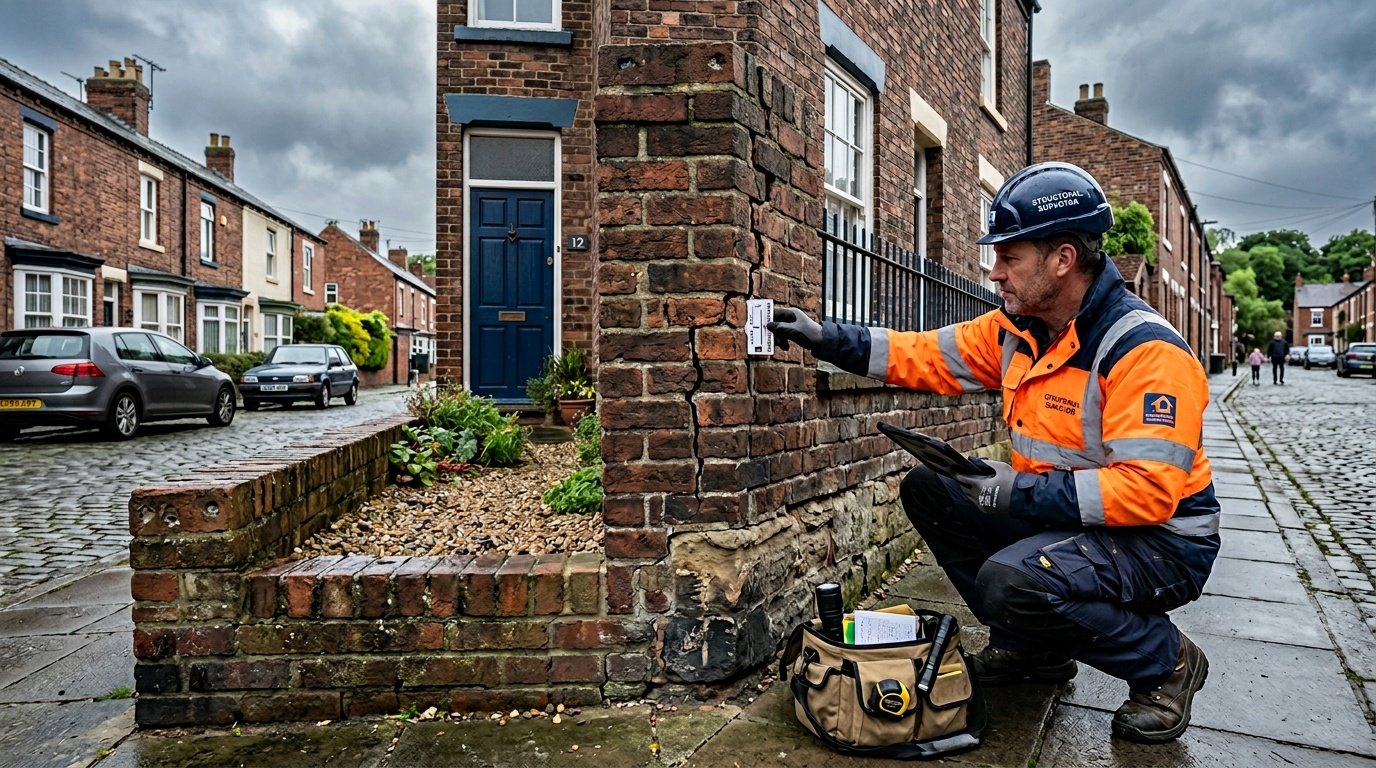
Bolton's housing stock is wonderfully varied — but its older properties come with some predictable structural quirks. After surveying hundreds of properties across the town and surrounding areas, I've built up a good picture of the structural issues that come up again and again. Here are the five most common structural problems I encounter in Bolton homes.
1. Subsidence and Settlement
Subsidence — the downward movement of the ground beneath a building — is a serious structural issue that can be extremely costly to remedy. In Bolton, the main causes include:
- Clay soils: Some areas of Bolton have clay-rich soils that shrink in dry summers and expand in wet winters, causing cyclical movement
- Tree roots: Large trees close to a property can extract moisture from clay soils, increasing subsidence risk
- Old mine workings: Parts of Bolton and the surrounding area have a history of coal mining; legacy mine workings can occasionally cause ground instability
The key signs to look for are diagonal cracks extending from corners of windows and doors (particularly tapering cracks that are wider at the top), doors and windows that stick or bind, and sloping or distorted floors.
Not all cracks mean subsidence — differential settlement (some movement after construction) and thermal expansion can both cause superficial cracking. A Level 3 Building Survey will assess the cracking pattern and give you a clear professional view on whether further investigation is needed.
2. Defective or Failed Roof Structures
Bolton's older properties — particularly those with hipped roofs, valleys, and older flat roof extensions — are prone to a range of roof-related issues. The most common include:
- Failing or absent hip and valley lead flashings, allowing rainwater penetration
- Sagging or distorted roof timbers, often caused by long-term moisture damage or inadequate original construction
- Failed or slipped plain clay tiles (still very common on Victorian terraces)
- Flat roof extensions with failed felt or deteriorating bitumen membranes
During a building survey, I always access the loft void to inspect the roof structure from the inside — and this frequently reveals problems that aren't visible from the exterior.
3. Failed or Inadequate Chimney Stacks
Chimney stacks are one of the most maintenance-intensive elements of any older property — and they're often neglected. In Bolton's Victorian housing stock, I regularly find:
- Failed pointing to chimney stack brickwork, allowing water ingress
- Cracked or displaced chimney pots
- Deteriorated lead flashings at the junction of the chimney and roof covering
- Structurally deficient chimney breasts (particularly where chimney breasts have been removed internally)
— James Whitfield, Lead Surveyor
4. Lintel Failure Above Openings
Lintels are the structural beams above windows, doors and other openings that carry the weight of the wall above. In older Bolton properties, three types of lintel failure are common:
- Corroded steel lintels: Properties built between roughly 1920 and 1980 often have steel lintels which, once moisture penetrates, expand as they corrode and push the masonry above outward, creating characteristic horizontal cracks
- Failed natural stone lintels: Stone lintels in older properties can crack or spall, sometimes requiring complete replacement
- Inadequate timber lintels: In very old properties, timber was often used as a lintel, and these can rot or deflect over time
5. Timber Decay and Woodworm
Timber decay — whether from wet rot, dry rot, or woodworm infestation — is surprisingly common in Bolton's older housing stock. Areas particularly at risk include:
- Subfloor timbers in properties with suspended timber ground floors and inadequate under-floor ventilation
- Roof timbers in poorly ventilated or leaking roof spaces
- Window and door frames in properties with failed glazing seals or repointing
- Timber lintels and bressummers in very old properties
Woodworm (the larvae of several species of wood-boring beetle) is common in older untreated timbers. The key indicator is the presence of small circular flight holes. Not all woodworm is active — I assess whether an infestation is historic or current as part of a building survey inspection.
What to Do if You're Buying a Bolton Property
The best protection against any of these structural issues is commissioning an appropriate independent survey before you exchange contracts. For older Bolton properties, I'd always recommend a Level 3 Building Survey. This gives you a full structural assessment, repair cost guidance, and the information you need to negotiate effectively with the seller.
Some signs are visible to a careful observer — diagonal cracks, sloping floors, stuck doors. But many structural issues are hidden behind plasterwork, beneath floors, or in the roof void. A professional surveyor has the training, equipment and legal responsibility to identify all accessible defects.
Not always. Many chimney repairs, for example, cost a few hundred pounds. Lintel replacement might cost £1,000–£3,000 for a standard opening. It's the more serious issues — subsidence, extensive rot, significant roof structural failure — where costs can escalate. Our Level 3 survey includes estimated repair costs to give you a realistic picture.